

Critical Care 2024, 28(Suppl 1):P220 · 2024
Hemoperfusion with Efferon LPS NEO device reverts multiple organ failure, decreases IL-6 and TNF levels and systemic immune inflammation in children with sepsis
Abstract
Introduction: Pediatric sepsis is a major life threat due to multiple organ failure (MOF) progression and resistance to conventional therapies. Extracorporeal hemoperfusion (EH) using Efferon LPS adsorber abrogates MOF and halts septic shock (SS) in adult patients [1]. Here, we report case series of children with sepsis to assess the feasibility and safety of EH with a new pediatric Efferon LPS NEO device (PE).
Methods: PE contains porous polymeric scaffold with the surface-immobilized LPS-selective ligand. Seventeen children (9 girls) with sepsis (10 with SS), average age and range: 26 (1–159 months), were included in the study following Ethical Committee approval. Children received two treatments, lasted ≥ 4 h, 24 h apart, with PE. The blood cell count, levels of C-reactive protein (CRP), procalcitonin (PCT), creatinine, urea, ALT and AST were monitored on days 0, 1, 2, 3, 5, 7 and 14. Plasma IL-1b, IL-6 and TNF were determined on days 0 and 3 after the inclusion into the study. STATA 16.0 (StataCorp, USA) were used to assess significance.
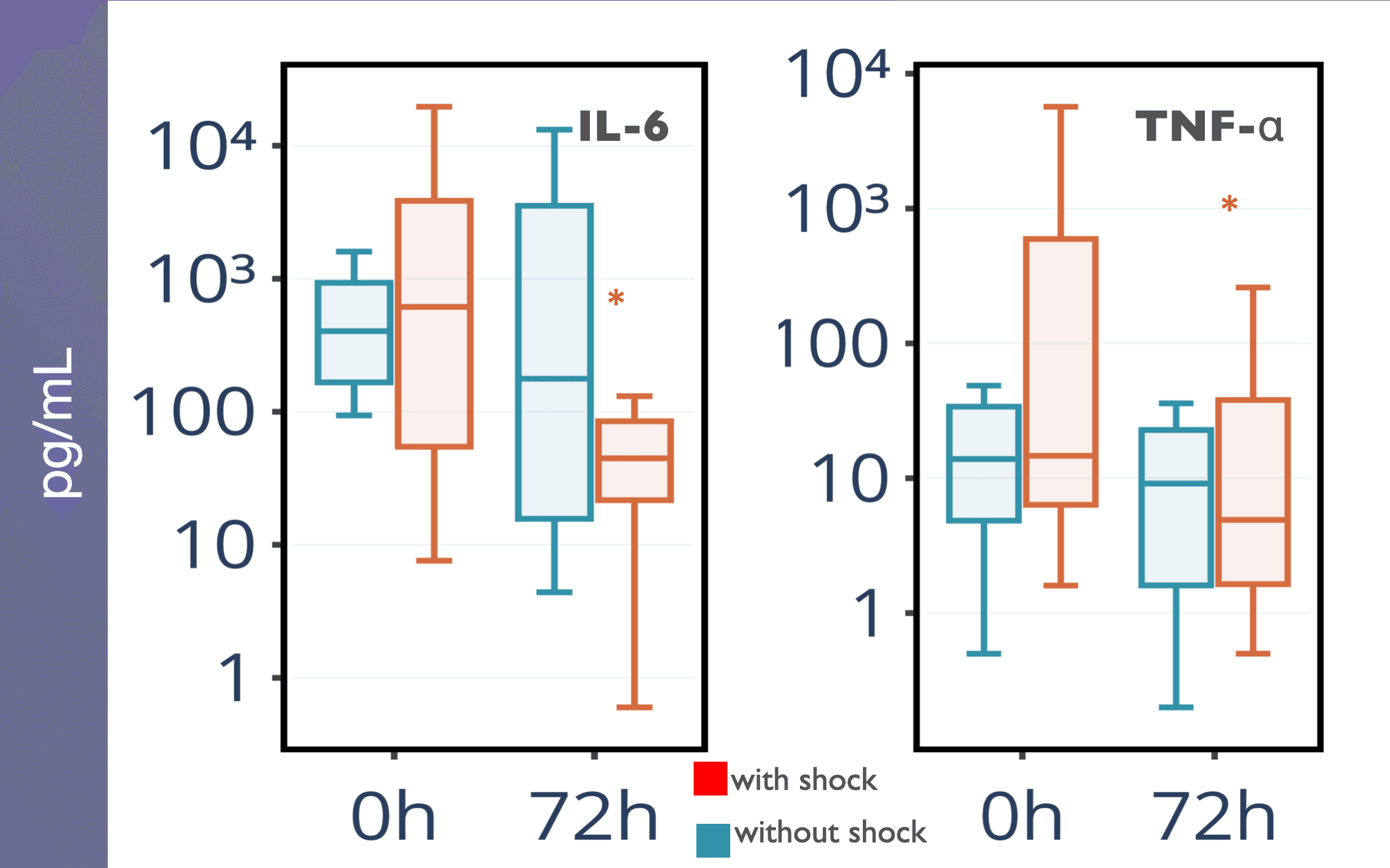
Results: In SS patients, EH resulted in: (a) early abrogation of shock as confirmed by a decrease in vasopressors dose (Figure panel D), (b) MOF reversal as determined by pSOFA (p = 0.003, Figure panel A), (c) lower creatinine (p = 0.006, Figure panel C) and C-reactive protein levels starting from days 2–3, (d) increases in PaO2/FiO2 index on days 7 and 14 (p = 0.004, Figure panel B). Children exhibited significantly decreased cytokines levels concentration in 72 h post-EH (Figure panels F and G). In non-SS children, the cell ratio-based biomarkers exhibited early vs late prognosis for SII and NLR (Figure panels I and H, respectively). Decreased thrombocyte levels on days 1–3 post-EH were normalized on day 7. Only 2 of 17 most severely ill children with refractory SS have deceased by the 60 day.
Conclusions: These results argue for feasibility and safety of EH with PE in pediatric sepsis.
More publications
- Eferon LPS NEO hemoadsorption in pediatric sepsis patients: a multicenter controlled studyESICM LIVES 2025. ICMx 13 (Suppl 1), 109 (2025). · 2025
- Multimodal LPS-selective hemoadsorption combined with hemodiafiltration in the intensive care of gram-negative sepsis: a multicenter observational study.General Reanimatology. 2025;21(6):4–12. · 2025
- Hemoperfusion using the LPS-selective mesoporous polymeric adsorbent in septic shock: a multicenter randomized clinical trialShock. 2023 Jun 1;59(6):846-854 · 2023
- Extracorporeal adsorption of cytokines in cytokine release syndrome in a patient with acute lymphoblastic leukemia after therapy with T cells with a chimeric antigen receptor. Clinical observationTherapeutic archive. 2021; 93 (7): 811-817 · 2021
- Application of novel device Efferon LPS in hemoperfusion for simultaneous removal of endotoxin and cytokines in a patient with septic shockWorld Journal of Medical Case Reports. Vol. 2, No. 3, 2021, pp. 46-50. · 2021
- Hemosorption carried out by a column filled with hypercrosslinked styrene-divinibenzene copolymer with an immobilized LPS-selective ligand in a complex of intensive treatment of acute lung injury in the surgical treatment of lung cancer (clinical observation)General resuscitation. 2020; 16 (4): 14-20. · 2020
- Application of adsorbent based on a hypercrosslinked styrene-divinylbenzene copolymer with an immobilized LPS-selective ligand in hemoperfusion for the treatment of patients with septic shockGeneral resuscitation. 2020; 16 (6): 31-53. · 2020
- Efficiency and safety of a new product for LPS-selective hemosorption (experimental study)General resuscitation. 2018; 14 (6): 51-60. · 2018
- Polymeric sorbent, method for its production and use.Invention patent RU 2653125 C1. Date of registration: 23.05.2017 · 2017
- Method for determination of bacterial endotoxin in biological fluids.Invention patent RU 2691413 C1. Date of registration: 26.12.2017 · 2017
- Methods for the determination of bacterial endotoxin in critical care medicine (review).General resuscitation. 2017; 13 (5): 109-120. · 2017
- Sorbents for extracorporeal removal of toxic substances and molecules with unwanted biological activity (review)General resuscitation. 2016; 12 (6): 82-107. · 2016