

Intensive Care Medicine Experimental 2022, 10(2): 000710 · 2022
Extracorporeal hemoperfusion with Efferon LPS for rapid reconstitution of vital parameters and decreasing proinflammatory biomarkers in patients with intra-abdominal sepsis
Abstract
Introduction: post-surgery infections in ICU cause intra-abdominal sepsis (IAS) including septic shock associated with increased mortality. Rapid abrogation of endotoxin and\or excess of cytokines using extracorporeal hemoperfusion (EH) therapies may improve treatment outcomes in patients with septic shock [1-5].
Objectives: to evaluate the efficacy of the Efferon LPS device in extracorporeal therapy in patients with IAS complicated by septic shock.
Methods: thirty-three post-surgery patients admitted to the same ICU (20 men and 13 women, average body mass 88 kg, median age 67 years, range 39-89 years, with IAS, complicated by septic shock as revealed by SEPSIS-3(2016) criteria) were subdivided in two groups. One group received conventional treatment for septic shock (control, n=13), another one additionally underwent EH (n=20). EH was carried out by Efferon LPS adsorber containing cytoking-adsorbing mesoporous hypercrosslinked polystyrene beads with surface-immobilized LPS-selective ligand [5-8]. During three days, patients were receiving 1-2 EH procedures, a day apart, 4-6 hours each, using MultiFiltrate blood perfusion machine (Fresenius) at a rate of 100-150 ml/min, followed by continuous veno-venous hemodiafiltration. Groups did not differ significantly in age and sex, and in any of the parameters studied except PCT (Table, day 0). Statistical analysis was performed using Microsoft Excel with Real-Statistics add-in and XLStat (USA). Significance of intergroup differences was determined by Student’s t test, Wilcoxon test, or Mann-Whitney test, whatever appropriate, and significance of differences was considered at p<0.05.
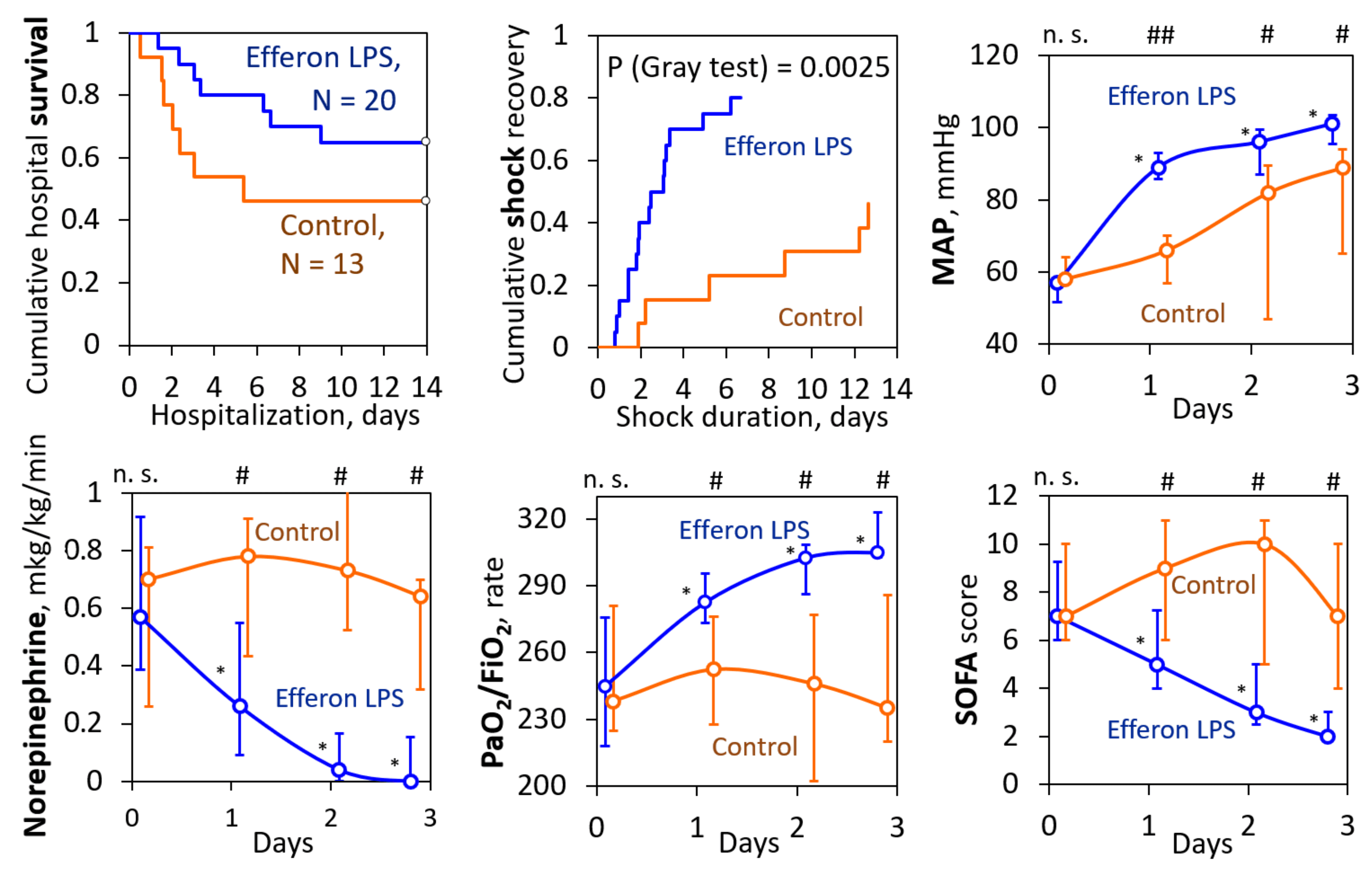
Results: mortality during septic shock tended to decrease in EH patients vs.control group at a marginal significance (P=0.065). There was a trend in increased survival in 3, 7, and 14 days post- EH vs. control. EH resulted in a significant 4-fold decrease in septic shock duration in survived EH patients: 46(34-74) hours vs. 168 (71-272) hours (HE vs. control patients, respectively,cP=0.0025), accompanied by decreasing endotoxin and IL-6 levels, SOFA score, leukocyte, CRP, lactate and creatinine levels, whereas PaO2/FiO2 oxygenation index and MAP values were increasing. The most significant effects were revealed in patients <80 years old. EH led to rapid decreasing the multiple organ failure in patients exhibiting both lower (<8) and higher (>8) SOFA scores values. In contrast to a control group, on day 3 post-EH patients did not require norepinephrine support any more.
Conclusions: EH with Efferon LPS adsorber resulted in rapid improval of vital indices (SOFA, MAP, oxygenation index) and proinlammatory biomarkers (IL-6, PCT, CRP) in IAS patients associated with a rapid shock abrogation and a trend to decreasing mortality in an ICU setting.
1. Rachoin JS et al. Crit Care Explor. e0083, 2020.
2. Wei T et al. Medicine (Baltimore) 99: e19632, 2020.
3. Kogelmann K et al. Critical Care, 21:74-83, 2017.
4. Lipcsey M et al. Shock 54:224-231, 2020.
5. Ham SY et al. Sci Rep. 10: 21513, 2020.
6. Morozov AS et al. General Reanimatology 12:82-107, 2016.
7. Khoroshilov SE. et al. General Reanimatology 14: 51–60, 2018.
8. Ushakova ND et al. General Reanimatology 16: 14-20, 2020.
More publications
- Multimodal LPS-selective hemoadsorption combined with hemodiafiltration in the intensive care of gram-negative sepsis: a multicenter observational study.General Reanimatology. 2025;21(6):4–12. · 2025
- Eferon LPS NEO hemoadsorption in pediatric sepsis patients: a multicenter controlled studyESICM LIVES 2025. ICMx 13 (Suppl 1), 109 (2025). · 2025
- Hemoperfusion with Efferon LPS NEO device reverts multiple organ failure, decreases IL-6 and TNF levels and systemic immune inflammation in children with sepsisCritical Care 2024, 28(Suppl 1):P220 · 2024
- Hemoperfusion using the LPS-selective mesoporous polymeric adsorbent in septic shock: a multicenter randomized clinical trialShock. 2023 Jun 1;59(6):846-854 · 2023
- Application of novel device Efferon LPS in hemoperfusion for simultaneous removal of endotoxin and cytokines in a patient with septic shockWorld Journal of Medical Case Reports. Vol. 2, No. 3, 2021, pp. 46-50. · 2021
- Extracorporeal adsorption of cytokines in cytokine release syndrome in a patient with acute lymphoblastic leukemia after therapy with T cells with a chimeric antigen receptor. Clinical observationTherapeutic archive. 2021; 93 (7): 811-817 · 2021
- Application of adsorbent based on a hypercrosslinked styrene-divinylbenzene copolymer with an immobilized LPS-selective ligand in hemoperfusion for the treatment of patients with septic shockGeneral resuscitation. 2020; 16 (6): 31-53. · 2020
- Hemosorption carried out by a column filled with hypercrosslinked styrene-divinibenzene copolymer with an immobilized LPS-selective ligand in a complex of intensive treatment of acute lung injury in the surgical treatment of lung cancer (clinical observation)General resuscitation. 2020; 16 (4): 14-20. · 2020
- Efficiency and safety of a new product for LPS-selective hemosorption (experimental study)General resuscitation. 2018; 14 (6): 51-60. · 2018
- Methods for the determination of bacterial endotoxin in critical care medicine (review).General resuscitation. 2017; 13 (5): 109-120. · 2017
- Method for determination of bacterial endotoxin in biological fluids.Invention patent RU 2691413 C1. Date of registration: 26.12.2017 · 2017
- Polymeric sorbent, method for its production and use.Invention patent RU 2653125 C1. Date of registration: 23.05.2017 · 2017
- Sorbents for extracorporeal removal of toxic substances and molecules with unwanted biological activity (review)General resuscitation. 2016; 12 (6): 82-107. · 2016